Monday, March 25, 2013

Adapting a textile design to applique


This is a mock-up for an applique design I adapted from the 1950's textile design seen in the photo below.  I ran across it in a nice little paper-back called "Fun Fabrics of the 50's" by Joy Shih, one of a series she's written on vintage fabrics. 

For the lattice I used random black scraps of linen and cotton; the turquoise is Guatemalan cotton from my sister Kelli's leftover sewing stash.  The orange is silk, and the green, Italian linen.  The inset in the orange is rayon from some old palazzo pants I made years ago, that due to the wide, flowy legs, keep providing me with scraps. I like how the patterns, textures, and weaves of the fabrics bring another layer of complexity to the design.

This could easily be a pillow front but I'm not in a big rush to make it into a "thing".   For now I'm just experimenting, figuring out what I do (and don't) like to do, and little by little developing a system for living with,  i.e. organizing, lots of scraps. Gotta long way to go on that one.  


Tuesday, March 12, 2013

Doce de Coco


Burlap, rayon pants, 1960' cotton dish towel, leftover sewing scraps, silk, Italian linen


Doce de Coco from the album Obrigado Brazil.
The clarinet on this song is fantastic!


Tuesday, February 19, 2013

Connections-- ancient sounds and language


                        This morning, as I was listening to the birds, I kept thinking about Oliver Sacks' ideas in the previous post --- that we as humans are connected to nature through geometric patterns.  I thought about the bird sounds being patterns, structured through rhythm and repetition, and how they bring me a sense of not just familiarity, but also of completion, of wholeness.


I wonder if the sound patterns, like geometric patterns are inside of us, if the vocalization of the birds is stored as auditory patterns somewhere in our evolutionary DNA, if bird calls are as much a part of who we are as a snowflake.


I was thinking of Clyde Connell's series of Swamp Song drawings in which she recorded the sounds of the bayou by making thousands of spontaneously generated marks, effectively creating her own written language as she listened to birds and other swamp sounds.


Like Connell, I grew up in Lousiana; when I was very young we lived in the southernmost part of the state where the distinction between what is land and what is water is never completely clear.  Here are some of my  sister's old photos from a notebook she made during the time we lived near Bayou Teche.


Bayous, birds, ancient sound, evolution-- the word that comes to mind is...

at·a·vism
 noun \ˈa-tə-ˌvi-zəm\

Definition of ATAVISM

1
a : recurrence in an organism of a trait or character typical of an ancestral form and usually due to genetic recombination
b : recurrence of or reversion to a past style, manner, outlook, approach, or activity atavism

Origin of ATAVISM

French atavisme, from Latin atavus ancestor, from at-(probably akin to atta daddy) + avus grandfather — more atuncle
First Known Use: 1833


Saturday, February 9, 2013

Oliver Sacks and "Hallucinations"


"Do the arabesques and hexagons, in our own minds, built into our brain organization, provide us with the first intimations of formal beauty?"


- Oliver Sacks, from his book "Hallucinations".   The quote references the geometric hallucinations that sometimes precede migraine headaches.  He points to this being a universal phenomenom, occurring in humans of all cultures, ages (Sacks himself experienced them as a three-year-old) and throughout history, one that connects us directly to nature through patterns-- an example being snowflakes.


"In this sense the geometrical hallucinations of migraine allow us to experience in ourselves not only a universal of neural functioning but a universal of nature itself."


- "Migraine-like patterns, indeed, can be found in Islamic art..."


"... in Zapotec architecture..."


"... Aboriginal artists in Australia..."


"..in Acoma pottery..."


"... in Swazi basketry..."


Saturday, January 26, 2013

Consider a vintage jacket


I've been thinking about sewing, and what it means to make a garment for oneself.  Where do you get your design ideas?  What are your priorities?  What fabric do you choose and why?

This is a jacket sewn by my great-grandmother, sometime in the late 19th, early 20th century.  My great aunt saved some of her mother's clothes, and a couple of weeks ago I pulled them out to have a look and think about what it might have been like to make clothes a century ago here in rural Texas.


The red fabric has an iridescent, slightly metallic sheen.  It's lovely to look at, but kind of stiff and itchy.  Maybe some kind of rough-weave silk taffeta?  I wonder about the availability and expense of acquiring such materials in what was then a remote settlement, barely a town, in central Texas.


The trim on the jacket is a beautiful brocade which reflects the Japonisme movement popular in art and fashion from the late 19th into the early 20th c.   An example is this William Merritt Chase painting from 1898 called "Japanese Print".


She looks so comfortable in her kimono and chair.


Here is a portrait of my great-grandmother wearing an ornate high-necked blouse, typical of the period. I wonder if she sewed it herself and applied all the lace and trim.
Beautiful, but still, surviving Texas summers without air conditioning, wearing clothing designed for life in Victorian England?  That must have been rough.  And corsets.  Everyone wore corsets.
Comfort, particularly for women, I don't think was high on the priority list.


Design ideas and patterns?  I bet the deliveries of fashion magazines from "back East" were much anticipated.   Shapes and cuts in fashion illustrations were probably studied down to the minute detail.


I love the care she took in structuring the lines of the jacket.  It seems she was determined to make something fashionable, elegant, civilized-- in other words, a frock that denied the harsh realities of living in rural Texas. I understand the patience required, the intense desire to "get it right", and the tremendous sense of accomplishment felt when things finally come together according to plan.

The top-stitched seams on the back of her jacket remind me of the V-detail on the back of the kimono top I made recently.


I'd like to think there's some kind of familial design synchronicity going on-- Japanese influence, attention to seam detail and construction-- although my fabric choices lean towards cotton and linen, and comfort is high on my priority list.

I also doubt I'll be spending as much or more time structuring the inside of the garment as the outside of it...


It's the inside that tells the real story....  many tiny hooks for the shell....

and many more for for the lining.
Got to stay buttoned up.


So much spontaneous, just-make-it-work hand sewing inside that stands in stark contrast with the neat lines and seams on the outside.


It's likely she sewed her clothes on this machine...


....pumping away on the foot pedal.
In the summer, that must have been really hot.


Go granny go.

Sunday, December 23, 2012

Bird drawings


I particularly like the eyes on this one, each looking in a slightly different direction.


Saturday, December 15, 2012

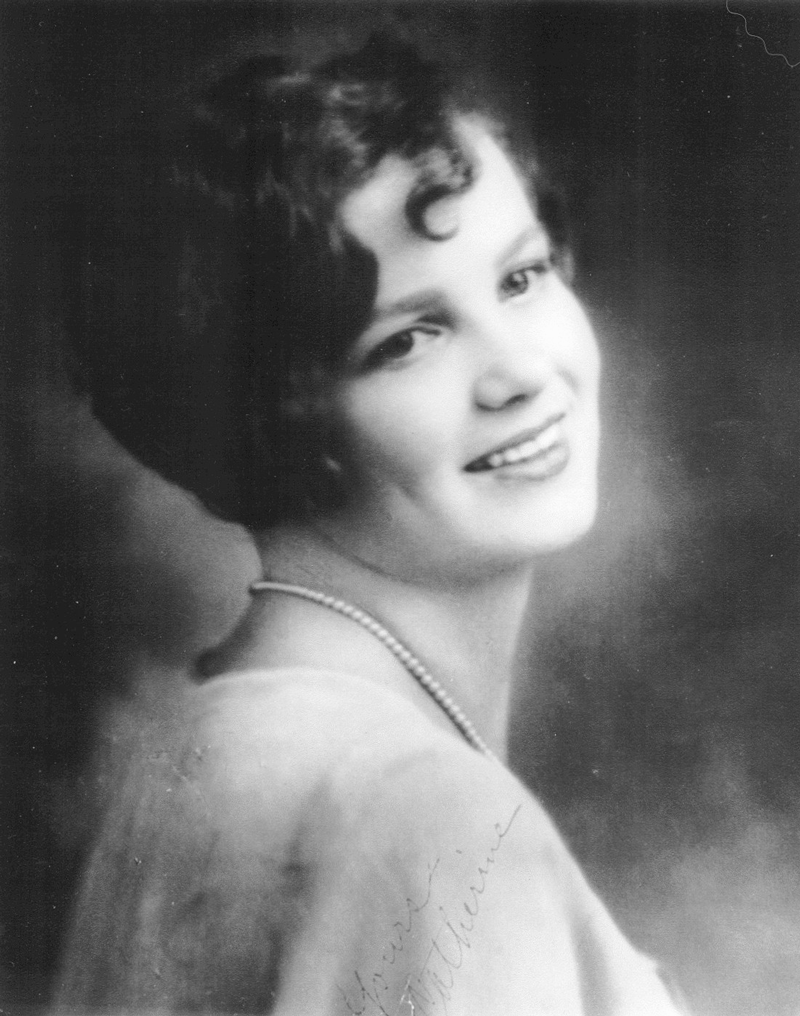
"My Quiet Book" -- a book written and made by my grandmother Catherine Hermes


This just turned up a couple of weeks ago after having been stored in the back of a closet for the past 40+ years.


It has so many things in common with some of my own recent work -- off-white cotton background, drawing with marker on cotton, felt shapes, applique, the use of black.  It amazed me to open it after so long and see so much of my own work in my grandmother's.


The book is all about being quiet and focusing on small tasks.
The brown pocket above held a pad and pencil.


The train cars can be unsnapped and rearranged.


 Love this big black shape of a shoe.


This Durer painting of St Jerome in his study perfectly captures the feeling of being quiet and looking at books.  I've spent many hours doing just that.


Thanks grandma.


Mary Catherine Hermes.
1907-1979